


One topic. One exercise.
The difference between a pull, a stack and a trip into the jungle that leaves your ally alone. I suggest understanding the action first, testing it in safe practice, and choosing one adjustment for your next match.
A pull changes the wave's route
A pull draws neutral creeps into an allied wave so the wave leaves the lane. It is a way to manage creep positioning, not a compulsory ritual for every support.
Assess what will happen to your ally in lane first. If the opponents can immediately go on them together, an elegant pull may cost your ally a death and a lost wave.
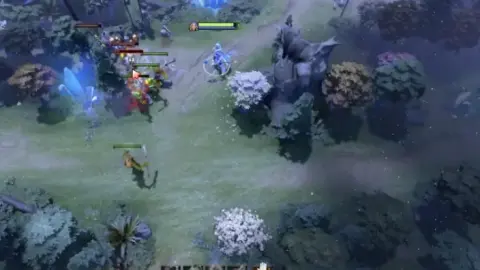 EXPLORE THE EXAMPLE ↗
The allied creeps have already turned away from the lane and are fighting neutrals near CM. That is the result of a pull. This frame comes from a 2020 tutorial: the camp locations are outdated, but the principle is still clear.
Luke Palmer · gameplay tutorial
A stack prepares resources for later
A stack increases the number of neutrals in a camp: you move them out of the spawn area before the next spawn check. If the area is occupied, a new camp will not spawn.
Your route, neutral movement speed and camp geometry affect when you should draw them out. Exact seconds are not universal: practise your chosen camp in the client and watch its boundaries.
Task first, timer second
Before leaving, tell your ally what you are doing. After the pull, return to lane or another useful task. Do not leave the carry alone just because ‘the guide says it's time to go into the jungle’.
Stacks are useful when the team can clear and protect them. A large camp near the enemy can also become a resource, just no longer yours.
Check the result, not just the neutral's movement
For a pull, what matters is that the allied wave actually changes its path and starts interacting with neutrals. For a stack, what matters is a new group spawning after the camp conditions are met. Similar hero movement does not mean an identical result.
The teaching images show the principle, while their camp locations belong to an old map. Check the spawn area and available route in today's client. Practise exact timing by observing the result, not copying someone else's number for another version.
«I do not want you to pull just to tick a box. I want the lane to make more sense afterwards and your ally to stay in the game.»
Ruslan Ukrainskyi · OOPS DOTA
- 01Check lane safety
- 02Distinguish a pull from a stack
- 03Change the neutrals' path
- 04Check the intended result
Try it in the client.
In safe practice, find a neutral camp near a lane. Check its location and whether it has creeps in the current client.
- 01
For a pull, draw the neutrals out and try to bring them into contact with your allied wave.
- 02
After the attempt, see what happened to the allied creeps and lane position.
- 03
For a stack, separately move the neutrals out of the camp before the next group spawns. Adjust the timing for this camp.
- 04
In a normal game, before leaving the lane, check whether your ally can survive the next trade without you.
How to tell whether it worked
You can show where a pull changed the wave's path and where a stack added a group of neutrals. Those are two different results.
You are ready to pull, but your ally faces an immediate attack from two enemies. What is the more sensible next step?
Choose an action and read the explanation.
Tried it in-game?
Mark the lesson when you’ve done the practice. It’s your checkmark, not a skill grade.
Next lesson ↗Sources and context
An original beginner course by Ruslan Ukrainskyi. The learning path was prepared on October 6, 2026 for patch 7.41f; check exact values, object locations and interactions against the current client and Valve’s source. Illustrations have separate captions: our own recordings, official demonstrations and clearly marked historical examples.
Valve: short practice scenarios and a glossary (2021) ↗Valve: heroes and ability descriptions ↗Valve: current patch 7.41f notes ↗