


One topic. One exercise.
A camp being nearby is not a reason to abandon the lane and start hitting it. What matters is what your hero can gain now and what the attempt will cost: time, health or an ally left alone.
A neutral camp is another source of resources
Neutral creeps do not travel down the lane with your wave. They live in camps and provide resources a suitable hero can collect. Different groups have different strengths and spawn conditions; do not assume every part of the jungle is equally difficult.
For a beginner, it helps to find a manageable camp first and see how much health and time it takes to clear. If your hero needs a long recovery afterwards or misses an important wave, the overall result may be worse than the gold gain suggests.
«I want to count both ‘how much I took’ and ‘what I missed while taking it’.»
Ruslan Ukrainskyi · OOPS DOTA

The lane and jungle compete for your hero's time
A wave can offer convenient resources and map pressure; a camp may be closer and seem calmer. The choice depends on visible opponents, your role and your hero's capabilities. If enemies disappear, recheck your usual jungle route too.
You do not need to learn a perfect farming circuit for every hero. Start with one short route and one reason for choosing it. Before moving, name what you are leaving: a lane, an ally, a tower or the chance to join the next fight.
 EXPLORE THE EXAMPLE ↗
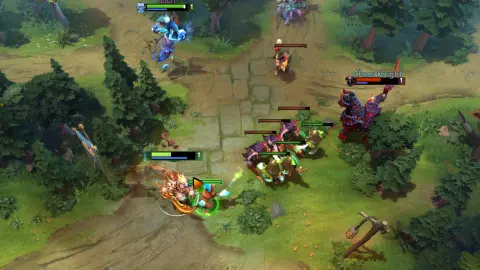
Farming means getting resources from creeps. Watch who takes the last hits, where it’s safe to stand and whose next item matters most to the team.
OOPS DOTA / Ruslan Ukrainskyi · own Juggernaut recording
A stack prepares resources, but someone has to take them
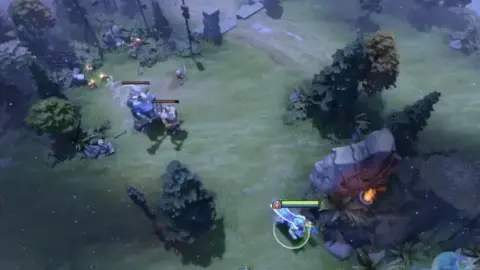
A separate lesson covers moving neutrals out of the spawn area. But a successful stack is not a resource the team has collected yet. A hero must be able to clear the larger camp without unnecessary risk.
Before setting it up, ask who can clear the camp and when. Do not send a low-health beginner into a large group just because it has spawned. The map in the teaching frame is old; separate the principle from today's camp locations and timings.
 EXPLORE THE EXAMPLE ↗
To stack, you move neutrals out of the spawn area so a new group appears in the camp. Stacking and pulling are different actions. The map in this recording is old; practise the timing in the current client.
Luke Palmer · gameplay tutorialResource priorities can be agreed
Positions reflect an agreement about resources, not a ban on supports attacking creeps. If a core is working towards an important item, your route should not accidentally take convenient farm right in front of them. If the resource would otherwise go to waste, the decision may be different.
A simple statement of intent often helps more than an argument after clearing: ‘I'll take this wave’, ‘I'm leaving the camp’, ‘I'm making a stack’. For solo practice, explaining why you took the chosen resource and which task it supported is enough.
- 01Assess available resources
- 02Account for the alternative I give up
- 03Choose a safe route
Try it in the client.
In a bot match, choose a manageable neutral camp. Do not try a large stack on a hero who cannot yet handle an ordinary group.
- 01
Before entering, assess your health, mana and information about nearby enemies.
- 02
Clear a small, manageable camp and notice the time and resources spent.
- 03
See what happened in the nearest lane during that time.
- 04
Compare this with taking an ordinary wave under safe conditions.
- 05
Say which option served your hero's task now, and who on the team needs the next resource.
How to tell whether it worked
You explain your choice between a wave and a camp through safety, your hero's capabilities and the alternative you gave up.
A large stack is ready, but your hero loses almost all their health to an ordinary camp. What is more sensible?
Choose an action and read the explanation.
Tried it in-game?
Mark the lesson when you’ve done the practice. It’s your checkmark, not a skill grade.
Next lesson ↗Sources and context
An original beginner course by Ruslan Ukrainskyi. The learning path was prepared on October 6, 2026 for patch 7.41f; check exact values, object locations and interactions against the current client and Valve’s source. Illustrations have separate captions: our own recordings, official demonstrations and clearly marked historical examples.
Valve: short practice scenarios and a glossary (2021) ↗Valve: heroes and ability descriptions ↗Valve: current patch 7.41f notes ↗