


One topic. One exercise.
In Dota, it is easy to chase the first red health bar and forget where the match is going. I suggest building a mental map first: where your team starts, where creeps meet and what opens the path to the Ancient.
The map has a route to victory
The fountain helps you recover and return to the game; the Ancient is the main building you must protect. The enemy has its own Ancient. Killing a hero can free up time to advance, but does not replace destroying the main building. Even a good fight therefore needs a next decision.
Three lanes connect the sides of the map. Creep waves travel along them, while towers make advancing harder. The jungle between lanes provides resources and routes around the enemy; it is not a safe room outside the match. Check the names and locations of additional objectives on the current map. Start with the stable framework: bases, lanes and river.
«I want your answer to “Where are we going?” to be a little better than “Following whoever ran first.”»
Ruslan Ukrainskyi · OOPS DOTA
A tower changes the situation, not just a health bar
Near a tower, you cannot judge a fight only by the number of heroes. Consider its attacks, your creeps, your ally’s condition and possible enemy arrivals. A wave reaching the building and a lone hero arriving there create different situations.
Destroying a tower opens space for further actions. But losing an enemy building does not make that whole side of the map yours: opponents may remain nearby and attack from an unexpected direction. Checking the minimap first is a better habit than automatically moving to the next tower.
 EXPLORE THE EXAMPLE ↗
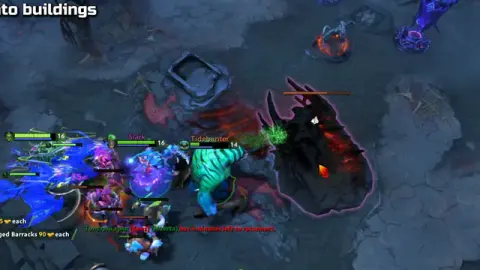
In my match, the team takes buildings after a fight. A successful push ends with the enemy losing an objective.
OOPS DOTA / Ruslan Ukrainskyi
River, ramp and base: watch the height
The river is often lower than nearby ground. A ramp leads uphill, and from below you may lack the vision you need above. “Going into the base” is therefore not just a few more steps: your team changes position and risks losing information.
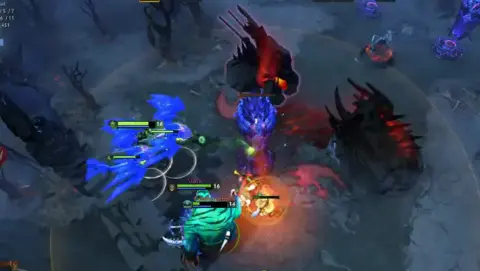
In the example, find the high ground, the ramp and the area before it. The image helps you recognize terrain, but does not prove the route in your match is clear. Before going uphill, answer these questions: where are the enemies, how does your team gain vision, and who can support the move?
 EXPLORE THE EXAMPLE ↗
Our team’s actual push into the Dire base. 1 — the base high ground; 2 — the ramp; 3 — the area before the ramp.
OOPS DOTA / Ruslan UkrainskyiThe minimap helps you choose your next question
Do not try to watch everything at once. In your first practice, periodically locate yourself, your nearest ally and the enemy’s last visible position. Then compare the minimap with your main view. An icon elsewhere on the map is a reason to refine your decision, not a guarantee that the other enemies are there too.
After a small success, ask: is there an accessible tower, a safe wave or a chance to return to farming nearby? If your team is not ready, retreating may be the right continuation. That connects the match objective to a specific action now, rather than an endless chase for kills.
- 01I find myself on the map
- 02I see the lane and tower
- 03I assess the route
- 04I choose the nearest objective
Try it in the client.
Open a bot match. Do not try to win in the opening minutes: explore the map with one chosen hero.
- 01
Find your fountain and Ancient, then find the enemy Ancient on the minimap.
- 02
Name the three lanes and follow the route of one allied wave.
- 03
Approach the river and a safe ramp: compare their height and visible areas.
- 04
Find the nearest enemy tower and explain what stops you attacking it right now.
- 05
After an enemy dies, name a possible next objective and the condition needed to move toward it.
How to tell whether it worked
You can distinguish a fountain, Ancient, tower, lane and ramp, and connect your team’s movement to the nearest objective.
Your team won a fight near a lane. Why should you not always run straight on into the base?
Choose an action and read the explanation.
Tried it in-game?
Mark the lesson when you’ve done the practice. It’s your checkmark, not a skill grade.
Next lesson ↗Sources and context
An original beginner course by Ruslan Ukrainskyi. The learning path was prepared on October 6, 2026 for patch 7.41f; check exact values, object locations and interactions against the current client and Valve’s source. Illustrations have separate captions: our own recordings, official demonstrations and clearly marked historical examples.
Valve: short practice scenarios and a glossary (2021) ↗Valve: heroes and ability descriptions ↗Valve: current patch 7.41f notes ↗