



One topic. One exercise.
How to earn gold in lane, avoid pushing without a reason and help your ally last hit. I suggest understanding the action first, testing it in safe practice, and choosing one adjustment for your next match.
Last hitting: the final attack matters
Enemy creeps are a regular source of resources. To earn gold from a normal last hit, land the killing blow. Constantly attacking the whole wave and last hitting deliberately are different actions.
Practise last hitting without abilities. Watch the creep's health and your attack's projectile speed. The aim is to get a feel for the timing, not set a record on your first try.
 EXPLORE THE EXAMPLE ↗
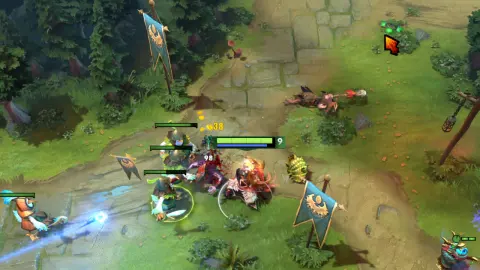
Watch the enemy creep next to Juggernaut: a sword strike finishes it off, and +38 gold appears after it dies. That is a last hit. The number belongs to this recording, not every creep bounty.
OOPS DOTA / Ruslan Ukrainskyi · own Juggernaut recording
Denies and lane equilibrium
A deny is the last hit on an allied creep when the game allows it. It limits what your opponent gains. Constant extra attacks on the enemy wave, by contrast, can move the point where creeps meet closer to the enemy tower.
If you have to step far forward for every last hit, think about how to bring the lane back to a comfortable position. A support can help with trades, pulls and consumables; endless auto-attacks on your ally's creeps often get in the way.

Harass without giving away a free death
Harass is damage that makes your opponent's lane harder. A good trade helps your ally last hit or forces the enemy to spend regeneration.
Before moving in to hit a hero, look at the wave and the other opponent. Enemy creeps may switch to attacking you: aggro is part of the trade too. One hit is not worth half your health and the next wave.
Reassess the lane after each small action
Last hits, trades and wave movement all happen at once in lane. As a beginner, choose one main question: am I taking resources, applying pressure or recovering right now? If you do everything without pausing, it is hard to notice why you lost health or why the lane moved.
After a wave, compare the creeps' position and your resources with the previous wave. Choose one adjustment for the next attempt, such as fewer unnecessary attacks or retreating sooner after a trade. More focused last-hit, aggro and trading exercises follow.
«One deliberate action in lane is more useful than constant attacks without understanding the result.»
Ruslan Ukrainskyi · OOPS DOTA
- 01Watch the wave
- 02Choose an action
- 03Check health
- 04Stay in lane
Try it in the client.
Open the last-hit practice mode if it is available, or start a bot match. Watch the creeps' health and the timing of your attacks.
- 01
For three waves, try attacking only to last hit. Record your last-hit count.
- 02
For another three waves, compare this with constant attacks: where did the meeting point of the creeps move?
- 03
As a support, try one trade with an enemy and return to a safe position.
- 04
Find a deny separately and compare it with a last hit.
How to tell whether it worked
You recognise last-hit timing and can explain why the wave pushed. The aim is not a perfect count on your first attempt.
Your carry is last hitting near your side of the lane. The enemy is not interfering yet. What should you check before attacking the entire wave?
Choose an action and read the explanation.
Tried it in-game?
Mark the lesson when you’ve done the practice. It’s your checkmark, not a skill grade.
Next lesson ↗Sources and context
An original beginner course by Ruslan Ukrainskyi. The learning path was prepared on October 6, 2026 for patch 7.41f; check exact values, object locations and interactions against the current client and Valve’s source. Illustrations have separate captions: our own recordings, official demonstrations and clearly marked historical examples.
Valve: short practice scenarios and a glossary (2021) ↗Valve: heroes and ability descriptions ↗Valve: current patch 7.41f notes ↗