


I have a talent for spotting a good target and forgetting how my own feet are taking me straight towards it. That is why I start choosing my position before I feel the urge to press my ultimate.
Find your job first
Before a fight, I ask myself: who needs stopping, who needs help, and who initiates? On Crystal Maiden, the job might be to set up an ally with a disable or find a chance to add Freezing Field. The job determines the position. If I need to cover a teammate, chasing the enemy support can easily take me somewhere else entirely.
A good position is one from which you can do the job. The farthest point on the map does not become useful just because it is safe.
The threat matters more than a nice camera angle
I check which enemies are visible and who can reach me quickly. When a dangerous hero goes missing, being off-screen does not mean they are on holiday. I leave some extra distance and a route back; retreating through my teammates is usually easier to read than moving deeper into enemy territory.
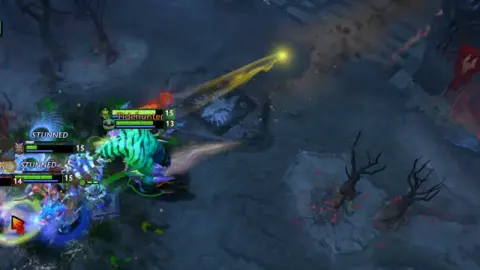
If I have to cross an exposed area to cast, I account for that route separately. At 04:40 in my episode, I do not have Blink yet: walking into range is part of the decision too.
 EXPLORE THE EXAMPLE ↗
In this match I play position four, but deal a lot of damage. My impact still depends on working with the team.
OOPS DOTA / Ruslan Ukrainskyi
An ally’s initiation gives you a cue
At 07:01, my allies start the fight before my Freezing Field. I join an action that is already underway. It is a good moment to ask: who are the enemies watching, and who can still interrupt my next move?
Wait for a specific opening. When an ally is already being finished off, endlessly thinking “I will find the perfect position in a second” is a mistake too. Sometimes an immediate, short disable is more useful than an ultimate you never cast.
Reposition after your cast
Your position changes with the fight. The target retreats, an ally moves further forward, an enemy appears from the side: the old patch of trees no longer does the same job. After taking an available action, I check whether I can help again or should back off.
Review one of your engagements in a replay using this checklist:
- Name your first cast and its target.
- Identify the threat and your escape route before stepping forward.
- Reassess after casting instead of chasing your usual target.
Practice scenario: an ally is ready to initiate. An enemy who can quickly catch your CM is missing from the map. How should you prepare to join?
Choose an action and read the explanation.
Sources and context
This is my approach to reviewing decisions. I check game data against the current patch and distinguish practice scenarios from events in my own match.
First OOPS DOTA episode: Ruslan’s Crystal Maiden game ↗